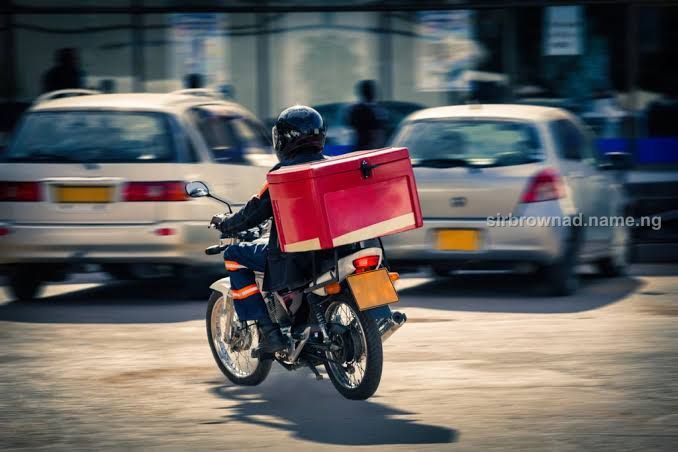
The order comes in through Instagram DM or WhatsApp. The customer seems legitimate — they ask the right questions, agree to your price, and tell you they will send their own dispatch rider to pick up the order because their preferred logistics company is faster.
You prepare the order. The rider arrives. He seems professional, mentions the customer's name, and says payment has been sent or will be sent on delivery. You hand over the goods.
The payment never comes. The customer's number goes unreachable. The rider is never seen again.
This is the fake dispatch rider scam — and it is one of the most common ways Nigerian Instagram and WhatsApp sellers lose merchandise daily.
When a customer sends their own rider before you confirm payment, they have already planned how this ends.
How the Fake Dispatch Rider Scam Works
Step 1 — The Order
The scammer places an order through your social media page or WhatsApp. They are specific about what they want, agree to your price with minimal negotiation, and establish enough rapport that you begin treating them as a real customer.
Step 2 — The Rider Announcement
Instead of paying upfront or using your recommended logistics service, they tell you they will send their own dispatch rider. They give reasons — "my company rider is faster," "I have a regular dispatch guy I always use," "he will pay you on delivery." All of these reasons sound plausible.
Step 3 — The Arrival
A rider arrives at your location. He knows the customer's name, knows what was ordered, and may even have a phone call with the "customer" that you are allowed to listen to — all staged to build your confidence.
Step 4 — The Handover
The rider either pays with a fake alert, promises payment will be sent immediately after he leaves, or uses the confusion of the moment to take the goods without any payment occurring. You hand over the order.
Step 5 — The Silence
The customer's number is switched off or blocked. The rider is unreachable. Your goods are gone.
Why This Scam Works So Effectively
The fake dispatch rider scam succeeds because it exploits the physical presence of the rider as a psychological anchor. When someone is standing in front of you, the social pressure to complete the transaction overrides your caution. You do not want to seem distrustful. You have already prepared the order. The customer is "on the phone." Everything has momentum.
Scammers understand this psychology deeply. The rider's physical presence is the final manipulation — designed to make releasing the goods feel like the natural, expected thing to do.
The Variations Sir Brown AD Has Documented
The fake alert variation:
The rider shows you a transfer alert on their phone as payment confirmation. The alert is fake. Never accept an alert on someone else's phone as payment proof — check your own account.
The "pay after delivery" variation:
The rider insists payment will be sent electronically the moment he leaves. He may even pretend to initiate a transfer in front of you. The transfer never completes.
The staged phone call variation:
The rider calls the "customer" who speaks to you directly, confirms the order, and tells you to release it to the rider. The person on the phone is an accomplice.
The bulk order variation:
The scam targets sellers with large orders — ₦50,000 to ₦200,000 worth of goods — because the higher value justifies sending a rider and the loss is more significant.
The Rules That Protect You
Payment confirms before any rider arrives.
This is the only rule that matters. No rider should be dispatched to your location until payment has confirmed in your banking app. If a customer sends a rider before payment confirms, that rider leaves empty-handed. No exceptions, no negotiations.
You recommend the logistics service, not the customer.
Your business, your process. Use your trusted logistics partners. A customer who insists on their own rider for a transaction where they haven't yet paid is a serious red flag.
Verify payment in your app, not on the rider's phone.
If a rider shows you a transfer alert on their phone, that tells you nothing. Open your own banking app and confirm the credit in your own transaction history. What appears on another person's phone is not your confirmation.
A phone call with the customer is not verification.
Scammers use accomplices. A voice on the phone confirming the order means nothing if you cannot independently verify who you are speaking with. Your confirmation is your bank balance — not a conversation.
For large orders, require full payment before preparation begins.
Do not prepare or package a large order until payment confirms. This eliminates the pressure you feel when a rider is standing in front of a completed order.
How to Communicate Your Policy to Customers
State your dispatch policy clearly on your social media pages and at the beginning of every transaction. Something as simple as this protects you:
"Our process: Payment confirms in our account first, then we package your order and release to logistics. We do not release to any rider before payment confirmation. This protects both parties."
Most legitimate customers respect this. Scammers will push back — and their pushback is your warning.
Conclusion
The fake dispatch rider scam is built on urgency, physical presence, and the social discomfort of turning someone away. Scammers count on you being too polite, too excited about the sale, or too unprepared to enforce your payment process in the moment.
Sir Brown AD wants every Nigerian seller to have their process so clearly established — and so clearly communicated — that there is no moment of doubt when a rider arrives without payment confirmed.
Your goods are your livelihood. They leave your hands only after payment enters your account. That is not rudeness. That is business.
Get new Security & Fraud alerts
One email when a new security & fraud article like this one goes live. No spam, unsubscribe anytime.